Operators are powerful processing units that modify video or audio content—or leverage media data to perform actions and calculations. From color correction to chroma keying, operators give you precise control over every aspect of your composition.
Common operators include Color Curves, Vibrance, and Chroma Key. While many operators function as visual or audio effects, others perform utility operations that extend beyond direct media manipulation.
How Operators Work
Operators are applied to layers within a scene. You can stack multiple operators on a single layer, and even apply the same operator type more than once for cumulative effects.
Operators are processed from top to bottom. Each operator calculates an outgoing RGBA value, which is then passed to the next operator in the pipeline.
Below are two examples of operators applied to a scene layer:
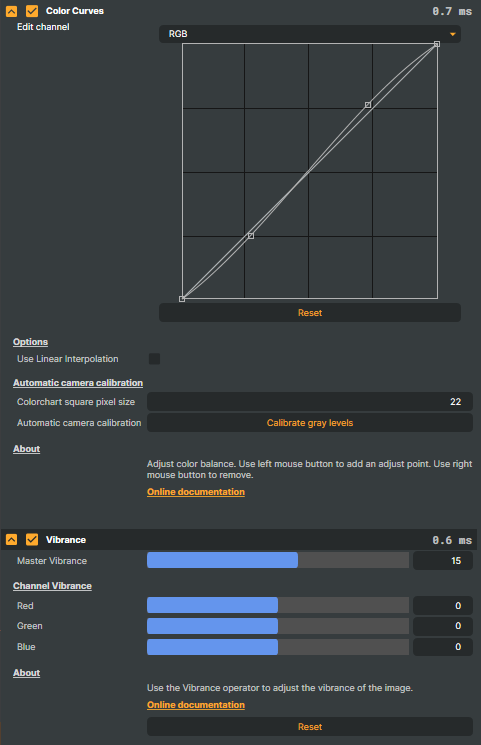
Working with Operators
Operators are located in the Operators tab on the left side of the interface.
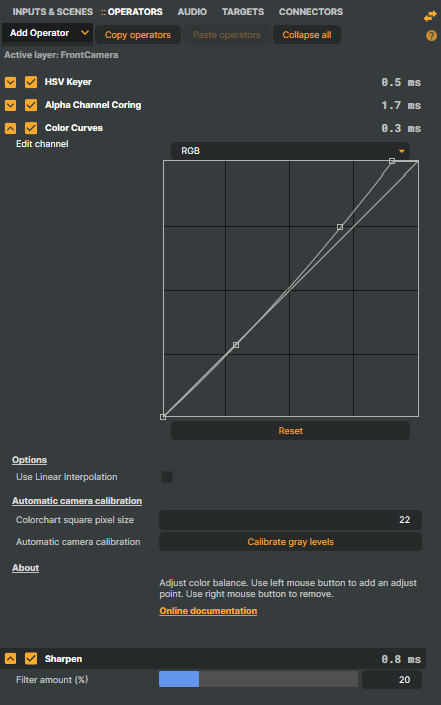
Adding an Operator
Select a Layer in your Scene, then use the Add Operator menu to apply an operator. The currently selected layer is displayed beneath the dropdown.
.png)
Managing Operators
Drag and drop operators to reorder them in the processing pipeline.
Click the yellow arrow-icon
.png) to expand or collapse an operator's settings.
to expand or collapse an operator's settings.Toggle the yellow checkbox
.png) next to an operator's name to enable or disable it.
next to an operator's name to enable or disable it.
Context Menus
Right-click on an existing Operator to open its context menu. Ex:
.png)
Right-click on an empty area to open the columns context menu. Ex:
.png)
Copying, Pasting, and Duplicating
To copy properties between operators of the same type, right-click the operator name and select
Copy operator properties. Then right-click the destination operator and choose Paste Properties.To duplicate an operator, right-click it and select
Duplicate operatorUse the
Copy OperatorsandPaste Operatorsbuttons to transfer all operators from one Scene Layer to another. This feature uses your system clipboard, making it easy to copy operators between servers.
Deleting Operators
To delete a single Operator, select it and press the [DELETE] keyboard button, or right-click the operator name and choose
Delete OperatorTo delete all Operators at once, right-click on an empty area and select
Delete all operators
Presets
Operator configurations can be saved as presets, allowing you to back up your pipeline or reuse it across multiple projects.
You can save/load presets in two ways:
Single Operator
Save or load the configuration of an individual operator.
Save - Right-click on the selected operator and select
Preset→Save as presetfrom the context menu.Load - Right-click on the target operator and select
Preset→Load from presetfrom the context menu.
Single operator presets are, by default, stored in:
C:\Program Files\RealSprint AB\Vindral Composer\Operators\[OperatorName]
All Operators (LayerOperators)
Save or load the complete operator pipeline for the selected layer.Save - Right-click on an empty area in the Operators column and select Save Operators as Preset. Choose a location to save the
.layerpresetfile.Load - Right-click on an empty area in the Operators column and select Load Operators from Preset to load your
.layerpresetfile.
LayerOperator presets are, by default, stored as
.layerpresetfiles in:C:\Program Files\RealSprint AB\Vindral Composer\LayerOperators
Extract To Window
Moves the selected operator into its own separate, floating window outside the main Composer interface..png)
💡Tip:
Extracting the window is useful when you want persistent access to an input’s settings or controls while working elsewhere in Composer, such as editing scenes, layers, operators, or targets. The extracted window remains visible and usable independently of the main UI, improving workflow efficiency on multi-monitor setups.
The input continues to function normally and remains part of the project — only its user interface is detached from the main window.
Custom Operators
Composer features a plugin-based architecture that supports the development of custom operators, inputs, and targets. Custom operators can be designed and built to meet your specific requirements, including:
AI-powered image analysis for object recognition and tracking
Third-party system integrations
Bespoke visual effects
Custom operator development is available through Professional Services provided by RealSprint. Contact RealSprint for more information.